It’s the cold that hits first
42 degrees is far from the 82 degrees
We left this morning in San Juan
And my body feels its jolt as we
Enter the plane’s jetway in Baltimore

The barrenness of the
Winter landscape hits next
As we cruise through interstate traffic
On our way home

Then, arriving home,
The usually much admired
Horizon visible from
Our apartment seems stark
Framed as it is
By curtain-less windows
With raised slatted blinds

Our view now seems
A Zen-scape of plainness
Offering only a gray sky and
Naked trees as backdrop
Our apartment itself,
Too sparsely decorated, even drab.
I feel bereft

Where is the color?
The warmth?
The life-giving nature of the Tropics?
The blues of the ocean?
The greens of the trees?
The grace of the swaying Royal Palms in the breeze?

The next morning however
As I sat with my beloved cup of coffee
In my comfy glider chair,
I realized I have something here
I don’t experience in the Tropics:

Anticipation of Spring:
The reawakening of Life
That faithfully erupts
Each orbit of the Earth
Around the Sun. I am calmed

I wonder too how I
Will feel when
All there is to anticipate
Is the end of anticipation
When only death awaits my physical body

I hope to recall even then
The eternal reawakening of
“What Is” –
So magnificently exemplified
By Mother Nature’s offerings.


Andrea DiLorenzo
February 23, 2025
Anticipation

It’s the cold that hits first
42 degrees is far from the 82 degrees
We left this morning in San Juan
And my body feels its jolt as we
Enter the plane’s jetway

The barrenness of the
Winter landscape hits next
As we cruise through interstate traffic
On our way home

Then, arriving home,
The usually much admired
Horizon visible from
Our apartment windows
Seems stark –
Framed by curtain-less windows
The slatted shades raised

Our apartment now seems
A Zen monument to plainness
Offering only a monotone gray sky and
Naked trees as a backdrop

Where is the color?
The warmth?
The life-giving nature of the Tropics?
The blues of the ocean?
The greens of the trees?
The grace of the swaying Royal Palms in the breeze?

I feel bereft
Wondering why I’d allowed
Such a spare environment
To exist in our living space

The next morning however
As I sit with my beloved cup of coffee
In my comfy glider chair,
I realize I have something here
I don’t experience in the Tropics:

Anticipation of Spring
The reawakening of Life
That faithfully erupts
Each orbit of the Earth
Around the sun
I am calmed

I wonder too what it
Will feel like when
All there is to anticipate
Is the end of anticipation
When only death awaits my physical body

I hope to remember even then
The eternal reawakening of
“What Is” –
Best exemplified by Mother Nature
And her magnificent offerings.


Andrea DiLorenzo
February 23, 2025
Class vs. Crass
My husband, John, and I recently attended an inspiring concert of the Baltimore Symphony Orchestra (BSO) at the 2,000 seat Strathmore Concert Hall here in Montgomery County, MD, a venue that is a 20-minute drive from our home. Strathmore was a public/private venture whose construction was funded by the State of Maryland and Montgomery County in the early 2000s. Before the concert began, we learned that, with this concert, the BSO was celebrating its twentieth year performing at this aesthetically and acoustically superb space. Guest artists such as jazz master Wynton Marsalis and opera diva Joyce DiDonato who we have seen performing in the past several years, both noted from the stage what an outstanding hall it is. We always attend events there with excited anticipation – and have never been disappointed.
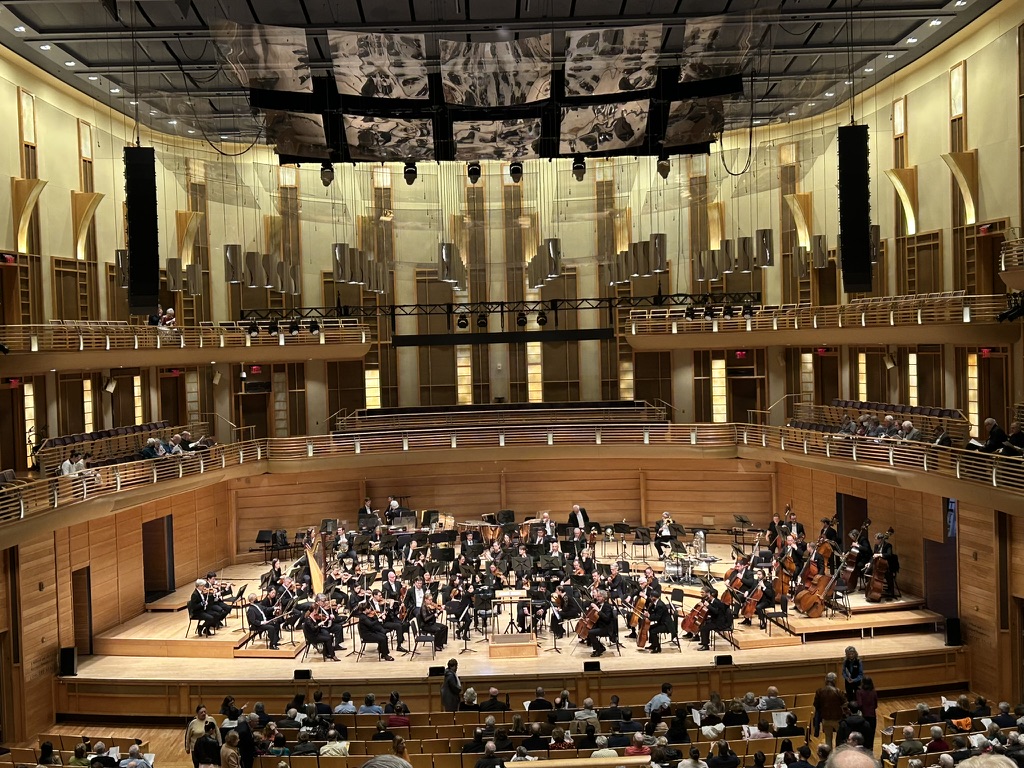
Such was the case at last night’s concert featuring Dvorak’s Carnival Overture, Montgomery’s Five Freedom Songs and Mahler’s Symphony No. 4. The concert was led by the effervescent 33-year-old Jonathan Heyward, named the orchestra’s music director in 2022. African American Heyward, a cellist by training, studied conducting at the Boston Conservatory, completing his degree at the Royal Academy of Music in London. Still in his twenties, he took the helm at several regional orchestras in England and led the Nordwestdeutsche Philharmonie in Germany before his current tenure at the BSO where he replaced renowned Maestra Marin Alsop.

I learned of African American artist Julia Bullock after we saw her German husband Christian Reif conduct the BSO at the Meyerhoff Hall in Baltimore in a 2022 concert featuring soprano Renée Fleming. In seeking information about Reif, I viewed videos on YouTube that Bullock and Reif recorded and posted during COVID in their Berlin apartment with him accompanying her silky, dramatic voice on the piano. I’ve followed this graduate of The Eastman School of Music’s trajectory ever since and remembered before buying tickets to last evening’s concert that she was a knock-out when performing with Metropolitan Opera stars Ailyn Perez and Angel Blue at the 2023 Kennedy Center Honors in the segment honoring Renée Fleming. I therefore anticipated Bullock’s greatness and was not disappointed.

The concert opened with a lively and engaging rendition of Dvorak’s Carnival Overture, a piece I remember fondly having performed in as an oboist in my high school’s orchestral band. Next on the program was Five Freedom Songs, composed by Jessie Montgomery, an African American violinist by training, and a graduate of The Juilliard School who is currently pursuing a Ph.D. in composition at Yale University. She recently completed a term as composer-in-residence at the Chicago Symphony and had been nurtured by the Sphinx Organization, a Detroit-based nonprofit that supports young African American and Latino string players.
Montgomery and Julia Bullock collaborated in the creation of Five Freedom Songs between 2017-2018. The Winter edition of the BSO magazine, “Overture,” noted that the two “wanted to create a song cycle that honors our shared African American heritage and the tradition of the Negro spiritual, while also experimenting with non-traditional stylistic contexts.” The songs were “sourced from the historical anthology Slave Songs of the United States,” originally published in 1867. Bullock sang with emotion and depth and, for some, in the vernacular in which they were sung by the enslaved people who developed them. The audience in the nearly full hall gave Bullock, Heyward and the orchestra a standing ovation, calling them back three times for more applause.
This appreciation was repeated for the performance for the Mahler symphony, a true masterpiece that especially featured the virtuoso playing of the wind section of the orchestra. Bullock joined them for the last movement that incorporated text from the “Das Himmlische Leben” (The Heavenly Life) taken from Das Knaben Wunderhorn (The Boy’s Wondrous Horn), a book of early 19th century German folk poetry. Again, she showed her mastery of the music, the language and her voice which soared above the festive sounds of the instruments.
As I rose, after both the “Songs” and Mahler’s 4th, applauding and cheering to acknowledge the greatness of these artists and the orchestra, I realized I was doing it not only to honor the blood, sweat and tears that I knew went into a performance of this magnitude by all the artists on stage. I was also aware that it was providing me with a spirit-lifting antidote to the news of the day emanating from the crass, even cruel, efforts of the Trump Administration – through its attack on DEI – diversity, equality and inclusion – to wipe out the programs supporting and honoring the artistic and musical contributions of those it deems “other” in our country.
An article in the February 27th, 2025 Washington Post, “Art museum run by OAS nixes two exhibitions,” focused on the Administration’s cancellation of two art exhibits due to open in mid-March at the Organization of American States in Washington. One, “Before the Americas,” was focused on the influence of the transatlantic slave trade and African diaspora across generations of modern and contemporary Black artists. The other, “Nature’s Wild With Andil Gosine,” had the theme of “queer theory and colonial law in the Caribbean.”
Another Post article on the same day, “U.S. Marine Band cancels concert over DEI orders,” focused on the cancellation by the Administration of an upcoming concert in Alexandria, VA in which thirty outstanding high school musicians from around the county, part of the “Equity Arc Wind Symphony,” were to perform with the US Marine Band. The musicians, representing the Black, indigenous, and people of color (BIPOC) community, were selected through highly competitive auditions. The concert would have featured traditional American music as well as the compositions of African American, Latino and Thai American composers.
I was angry and dis-spirited after having read those articles about the wrecking ball taken to these exhibits and concerts – and the aspirations of these artists and musicians by this Administration in the name of – What? An attempt to cancel the vital contributions of those who strive to create beauty and express themselves and the breadth of their experiences in our culturally and racially diverse country? I was on the precipice of feeling shame to call myself American.
Julia Bullock, Jonathan Heyward and the musicians of the Baltimore Symphony Orchestra brought me back from that precipice. They gave me more than a performance last night: they gave me hope and a reason to endure in the fight for justice, as the enslaved people who developed and sang those “Slave Songs” did over the centuries of their experience of violence and denigration. It will take more than an Administration steeped in cruelty, delusion and grievance to defeat that real American spirit. This is the American spirit to which I pledge my allegiance – now and for the remainder of my time on this earth.
Andrea DiLorenzo – 2/28/2025
A Spring Excursion Via Metro to Washington, DC 2024
How many cities exist where you can walk within minutes from one world-class museum to another? I’m not sure of the number, but I know Washington, DC is one of them and I’m happy to live close enough to its center to take advantage of this richness.
I had almost forgotten what walking around the National Mall of Washington can feel like since my husband John and I hadn’t made a foray there via the area’s Metro system since before COVID hit in 2020. On a chilly Sunday in April this year, we decided to take the plunge for what felt like a good opportunity to reconnect with DC via Metro. The experience fulfilled our hopes.
We had both regularly ridden Metro as commuters for decades while working. Even after retirement, we took the train to concerts at the Kennedy Center and other downtown venues. We loved living a mile from the end of the system’s Red line, the Shady Grove station. We could walk there and be close to the White House and other downtown points of interest within forty minutes or so. But COVID put a screeching halt to those outings. Even when things began to open up some in 2021, the January 6th insurrection at the Capitol led to a fenced-off closure of the National Mall, the site of so many treasured museums and monuments. Friends who visited there reported it felt like a scene out of the Twilight Zone. We lost our desire to head downtown.
Our first challenge this day was to find our way from our new home in the city of Rockville to the Rockville Metro Station. Since we had been accustomed to using the station near our former home, finding the parking lot and making our way into the new one took a bit of planning. We even used GPS though we only live about 4 miles away.

Once aboard the wide-bodied, Italian-designed cars now in use throughout the Metro system, I did what I always enjoyed most when commuting via Metro: I people-watched and listened for languages other than English. The ride did not disappoint. I was happy to reconnect with the ethnic, racial, cultural and age diversity in our area, something I’ve been somewhat removed from since moving two years ago to our continuing care retirement community populated largely by white, elderly people. On the train that day, I observed Latin Americans, Africans, Asians, single people, parents and grandparents with little ones in tow and many couples, straight and gay. I was reveling once again in the satisfying feeling of living in a large, cosmopolitan area, the reason I chose to come to Washington, DC after graduating from college in 1973.
The ride on Metro was just the first of many special moments that day. Coming up the escalator from underground next to the Smithsonian Castle and having the openness of the Mall greet us brought on a feeling of being part of something greater than our suburban village. We were in the nation’s Capital and the Capitol itself was right in front of us. Notwithstanding the many fraught political moments recently taking place within its buildings, being close to it physically reignited the importance of its symbolism and meaning as an institution of our democracy.

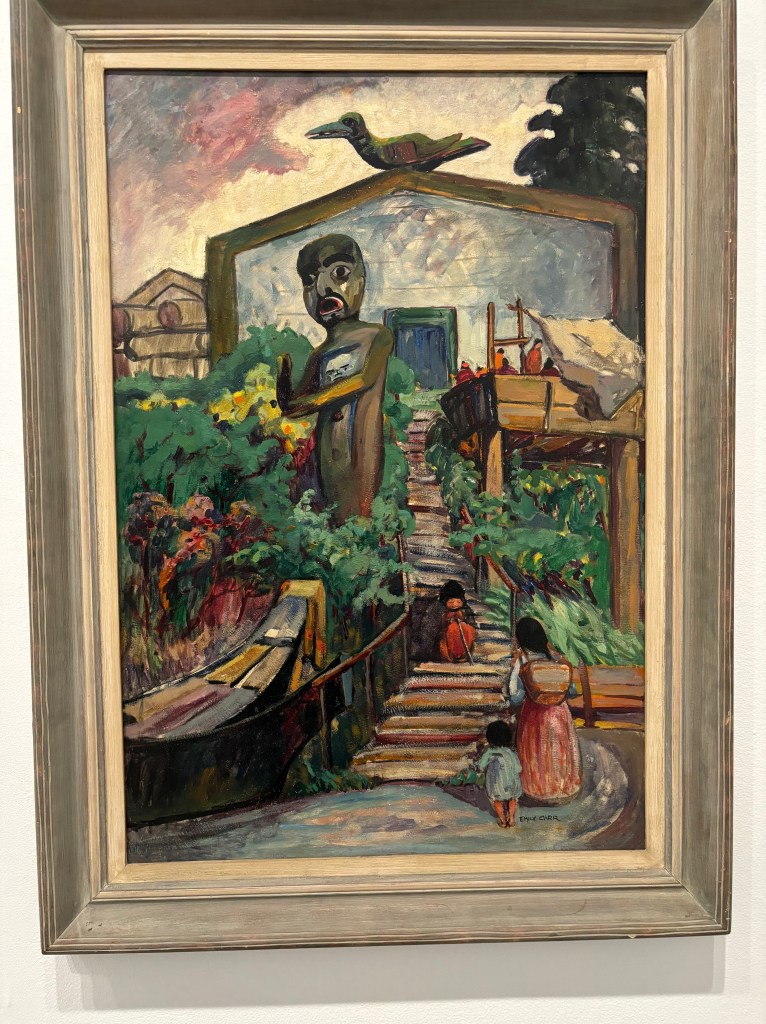
Our goal for the day was a visit to the Hirshhorn Museum’s exhibit, “Revolutions,” an exhibition of art made by 117 artists between 1860 – 1960, all part of its permanent collection. The juxtaposition of 19th century pieces, including for example, portraits of grand dames alongside those of contemporary African artists portraying everyday folks made it eye-catching and politically and intellectually engaging. We had only visited three galleries, seeing paintings by, among others, Canadian artist Emily Carr and American Edward Hopper, when a security guard discretely approached us, asking that we leave the building post haste as there was an “emergency” requiring evacuation. Along with the other hundred or so visitors, we quietly filed out, informing others on their way in of the situation.


The question became: what next? Since we were on the Mall, rather than shuffle out of the Hirshhorn feeling deflated after our precipitous leave-taking, we were surrounded by other offerings – several Smithsonian Museums and other art museums, the East Asian Freer Gallery and the National Gallery of Art, including its splendid East Wing. I have always loved the I.M. Pei-designed East Wing, so we headed directly there, a leisurely 10-minute walk from the Hirshhorn.
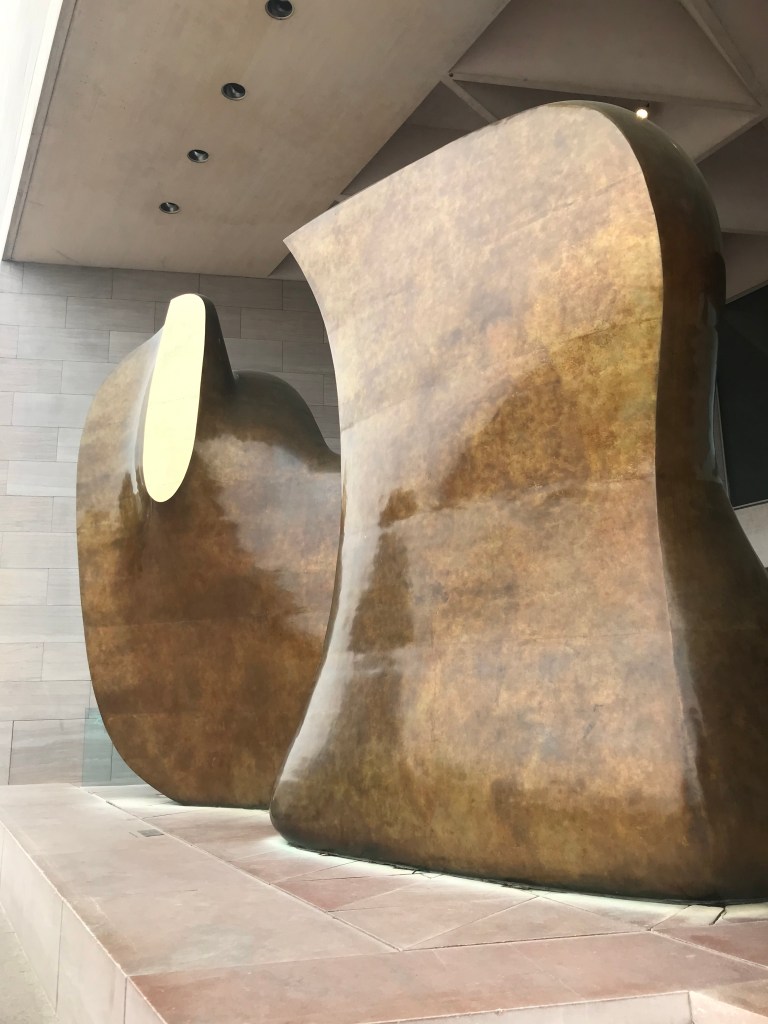
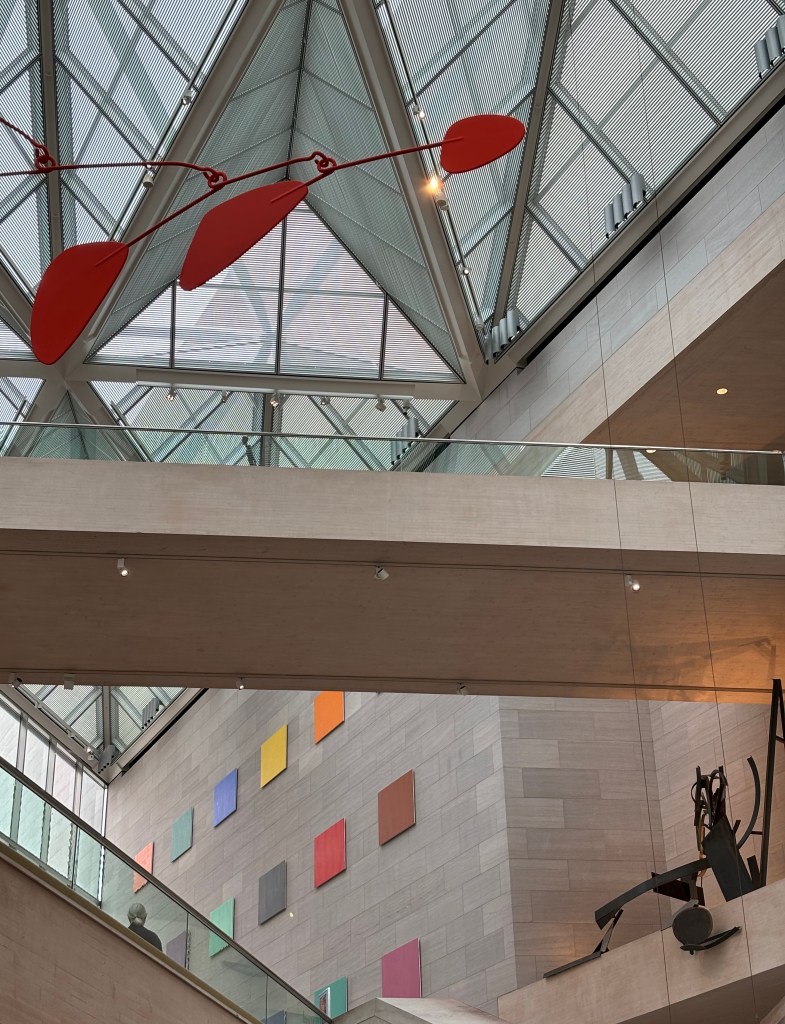
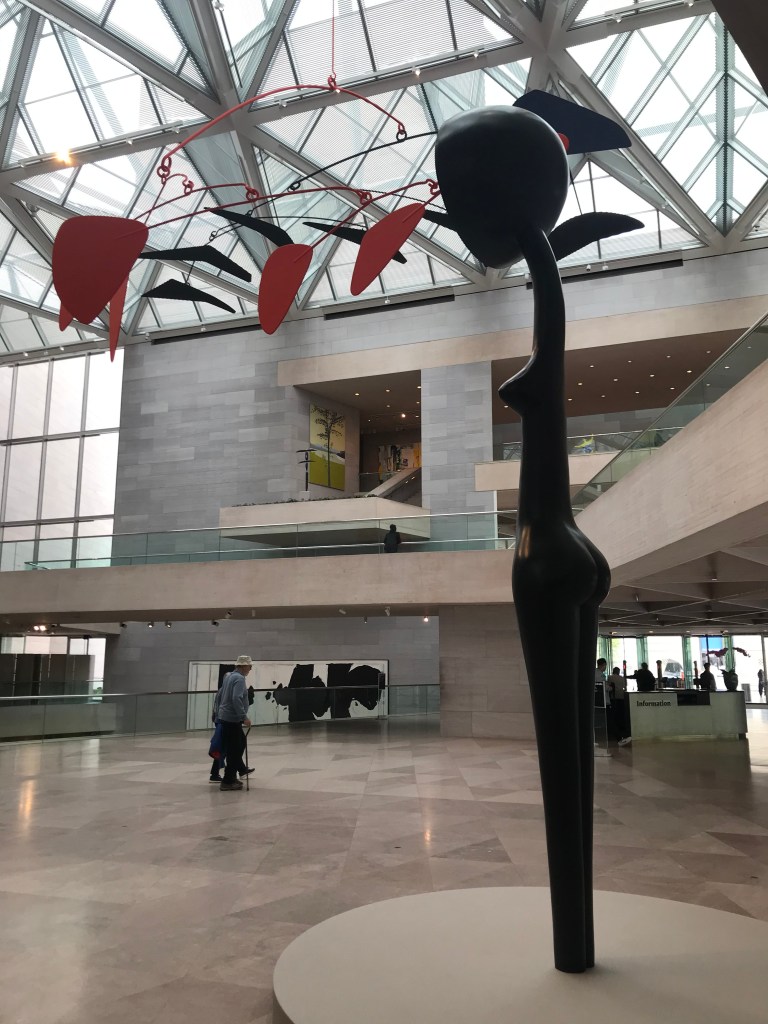
After passing the massive Henry Moore sculpture at the entrance, we walked through the museum’s Concourse, its main atrium. Its open and angular forms extending to its sky lights include a several ton Alexander Calder mobile hanging from the ceiling. I always marvel at how this artistic behemoth seems to be free-floating from its sky-high perch.
We then headed down the open staircase to our next delight at the below-ground level: the moving walkway connecting the East and West Wings of the Gallery. We were on our way to the Cascade Café for a late morning coffee. The walkway is surrounded on three sides by a flickering LED display that brings on a sense of walking through outer space. While I try to get in as many steps as possible in a day, here, I stand still, allowing myself to linger as long as possible on this marvel of lighting design and movement. If I had my druthers, I would ride back and forth all day letting the feelings of amazement and delight fill me, always as if it were my first time.

As we approach the West wing, I anticipate encountering the staircase-shaped, yards long and high, thick glass window up to the street level which holds back a cascading wall of water. Today the scene offered the enhanced pleasure of a string quartet comprised of young musicians playing a modern piece. People gathered around, cellphones ready, eager for this unexpected treat. The group finished playing their short piece and quickly disbanded, leaving us to our own conversation while enjoying our coffee and croissant.
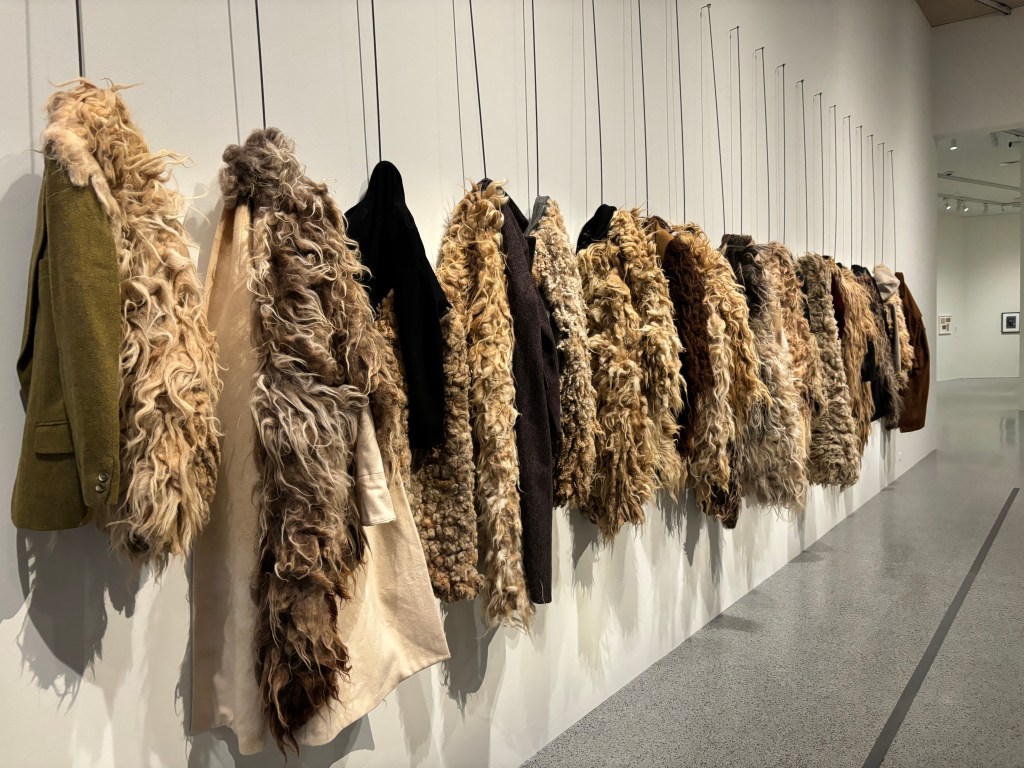
Next we took in the East Wing exhibit titled “Woven Histories: Textiles and Modern Abstraction,” whose focus was how techniques such as weaving, knitting, netting, knotting and felting, once considered “women’s work or domestic craft,” strongly influenced abstract modern art. The 160 works featuring fifty artists whose work challenged and delighted, bringing into the limelight those once “marginalized for their gender, race or class” as the museum’s website notes. One piece, named by the artist Ann Hamilton (side by side coats), featured woolen coats with raw fleece embedded within them. I learned that so many people wanted to touch the unprocessed fleece that the museum had to post a guard next to it to prevent that from happening, in other words, to remind visitors that the piece is art.
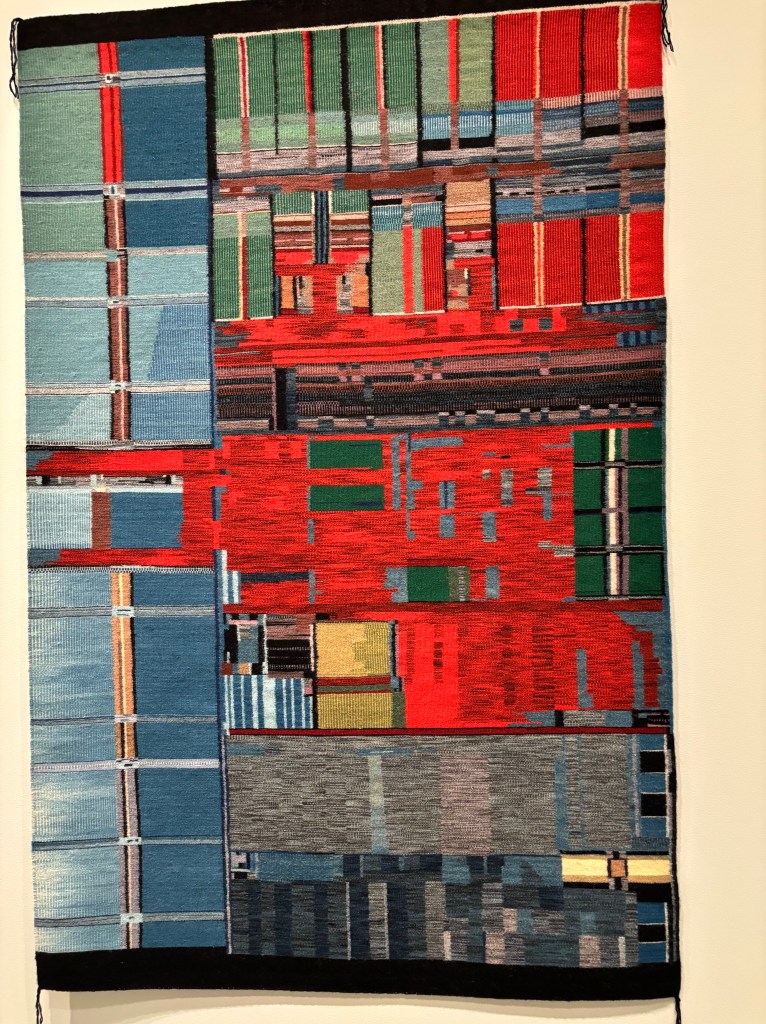
There were two other pieces I found particularly engaging, one titled “Replica of a Chip” and the other “Untitled (Unknown Chip)” done by Navajo/Diné artist Marilou Schultz. Schultz was commissioned by Intel Corporation to make the intricate woolen blankets based on the design of their Pentium microprocessor. This commission also honored the female workers Intel hired on Navajo/Diné land to assemble their circuit boards, citing their nimble finger work, honed on textiles, as the reason.
We completed sauntering through the textile exhibit ready to head home. We walked to the closest Metro station on the Red line, Judiciary Square, passing the courthouse where former-president Donald Trump’s trial for his role during the January 6th Insurrection would be taking place. Upon entering the Metro car a few minutes later, much to our surprise, just near the door, we encountered one of our close friends smiling at us. He was on his way to his gym. We reveled in the synchronicity of the event and felt it was a good omen for this first of what we hope will be many more Metro trips to the treasured offerings of our beloved capital, Washington, DC.
May 4, 2024
An October Day

The sunlight and clouds
Outside my apartment window
Keep offering a
Living, moving art museum
Of Autumn
On this blustery October day
In 2023

Andrea DiLorenzo, October 2023

On Turning 72
A Golden Crested Sparrow
Stunned itself this morning
After hitting into our
Living room window,
Landing on the
Balcony floor.

There it sat, still,
Alive but
Disorientated.
Did it have a future?

I checked on it
Every few minutes.
After a bit,
It had turned itself.
Hope.

Then it began to hop
Around the balcony.
More hope.

Eventually, it jumped onto the bottom rung
Of the railing,
Turning its head
This way and that while leaving us a dropping,

Waiting until
The right moment
Before flying off
For another day.

Like me, it was
Wounded, occasionally stunned,
But not yet
Down for the count.
							Andrea DiLorenzo - Nov. 7, 2023
Paean to A Summer Afternoon
From the corner perch
Of my second-floor balcony
I inhale the
Deliciousness of this
Splendid Summer Day

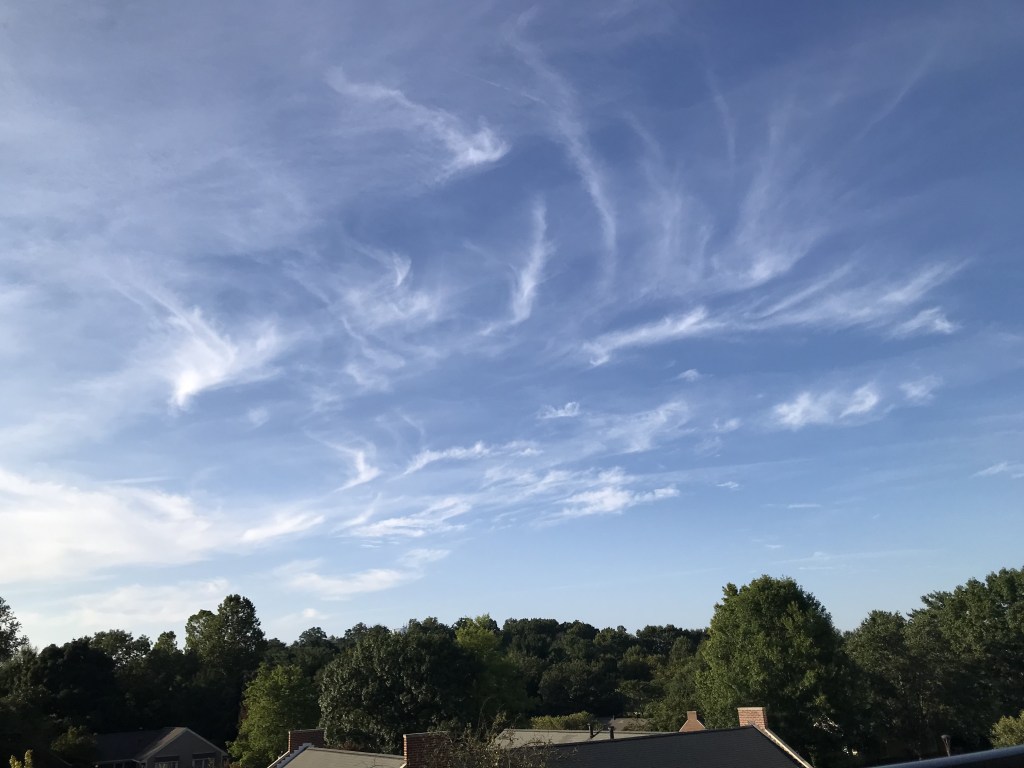
High cirrus clouds
Dapple the otherwise
Clear blue sky in
Feathering patterns

The array of green hues in the
At-their-peak trees
Are heightened by the
Light of the late afternoon sun

The breeze creates
Undulating movements at the
Top of the canopy
While sensuously caressing
My bare skin

I love feeling alive
And feeling my place in the
Midst of the
Majesty that is
Nature on a perfect Summer’s day


Andrea DiLorenzo
August 22, 2023
A (Four-Legged) Profile in Courage
Our second floor bedroom looks out into our backyard, one rimmed by large Loblolly pines, White Oaks and Maples. In the summer, it is a feast of green – so alive and nurturing of other life. I often enjoy that first glance of nature’s bounty when I open the slatted window blinds to let in the morning light.
Recently, while opening one of the blinds, something other than the verdant green of the leaves caught my attention. A mature Red Shouldered Hawk was perched in the middle of a dead limb on one of the pines, about thirty yards away from the house. I think the bird is part of the pair nesting and nurturing a fledging in a neighbor’s yard. Seeing such a large bird of prey so near is always an impressive sight.
That morning, however, I witnessed something even more impressive: a squirrel, less than a quarter the size of the Hawk, was sitting on another close-by, dead limb in the same tree. This limb was about three feet away from the other. The squirrel was completely vulnerable to the hawk’s predation. Yet, rather than heading in another direction, the squirrel actually jumped from its perch onto the limb holding the hawk. It then ventured out to about five feet from where the hawk was perched. I sat, anxious and in some awe, awaiting an attack by the hawk. Yet, the bird did not move. The squirrel repeated it actions, jumping from limb to limb for another couple of minutes. The hawk remained, seemingly frozen in time and place.
I clapped my hands thinking I would frighten one or both of them into leaving, sparing the squirrel’s life. No response from either animal. I was astounded that the hawk did not pounce on the squirrel and equally astounded that the squirrel kept confronting the predator – without consequence.
Suddenly, and without any visible impetus, the hawk left the middle of its branch and hopped out to the very end where it sat for several minutes more. I thought it might be seeking a better vantage point to pounce on the squirrel which kept up with its daring antics in clear view of the hawk. Then, all of a sudden, the hawk flew away without a sound and the squirrel walked away to see another day.
I assumed this feisty squirrel’s overriding goal was to protect a nearby nest, even to the point of losing its life. Though the squirrel is naturally programmed to preserve future life, my respect for this four-legged creature increased tenfold after witnessing this profile in courage. Why, I might even take down that baffle on my bird feeder and let the squirrels have a go at the seed.
June 20, 2019
Suburban Vultures: A Close Encounter – 2019
I remember the first omen: A rear car window splattered with dried droppings. I remember because the clean used car had been parked in our driveway only two days. We had just brought it home from having it repaired, a gift from a good friend to our daughter who had totaled hers earlier in the new year.
I didn’t like the look of what I saw but didn’t anticipate that it would be more than a “passing matter.” I didn’t, that is, until our driveway filled with more blatant signs of the presence of large birds of prey. We were rather clueless as to what we had in store for us. When I found large individual vulture feathers in the yard, I thought it quaint that we shared our airspace with these incredible soaring dinosaurs. John collected the feathers placing them on an outside window pane in a “bone” vase.
The real definitive presence of our vulture boarders revealed itself the day we returned from two weeks in Puerto Rico in late February. Given the number of pine and other branches strewn about our property, it was obvious that we had had strong wind storms while we were away. Strangely, the fallen Loblolly Pine branches all looked as if they had been sprayed white. What was going on? I didn’t put two and two together until a day or so later. The branches were white because they were coated with Vulture guano. I awoke more fully to the raptors’ presence.
Instead of becoming more concerned about the birds, I became fascinated with them. Each morning, they perched in the large trees behind our home. From the second floor, I was eye to eye with them about thirty feet away. I watched as they preened, spread and warmed their wings in the sun to warm up before flight and sat in their meditative, pre-workday quiet. I was smitten, I must say. How often might I come into such close contact with a large wild animal? I was capitivated.
However, after cleaning the guano from the driveway several times, John was less enamored with the visitors. The kettle, the name for a group of vultures, had about fifteen birds. We decided on action. One evening arriving from a meeting at dusk and seeing the vultures perched in the pines, we clapped and hooted and hollered for a few minutes. The birds were decidedly unimpressed. So John put down the guantlet to ensure that these interlopers found another ‘comfort inn’ at night.
As part of his efforts he read up on suburban vultures, even calling a wildlife specialist. This man then left a message detailing proven methods of getting the birds to move. Among them: setting off firecrackers, using air horns and even draping an effigy of a dead vulture over a branch of a roosting tree. He also said that vultures do not make nests, but lay an egg within a protected area of a tree. Once the egg was laid, the kettle would not be moving any time soon.
In the meanwhile, John developed another strategy: calling on his training in the Native American way, he attuned to the birds’ place in the universe, honoring their right to be, yet honoring ours as well not to have them in such close proximity. He then was determined to convey our conviction to benignly get them to another roosting site. I joined the effort.
John gathered two of our Native American hoop drums. We began to beat the drums when thee birds began their swirling descent to our tree tops. The drumming made quite a racket, echoing against our home and surrounding buildings. A funny moment in our endeavor came on Day 2. John had just spent about 30 minutes steadily drumming and successfully getting the birds to leave for the night. Our neighbor was picking him up for an evening meeting. I was to keep an eye out for any returning birds. Of course, when the drumming stopped, the vultures retured.
Ever on the ready, I began drumming again. The sound caught our neighbor’s attention. John brought him back to our patio and I greeted him, offering him the chance to join in our vulture-relocation program. He did so enthusiatically. I asked if he had thought on awakening that morning whether his day would include drumming vultures away from our backyard. He nodded “no” with a wry smile.
Along with drumming, when we had to be away for an evening around roosting time, John devised another plan. He took the old boombox from our basement and put it on the patio table, its speakers aiming up into the trees. He then blasted jazz from a local radio station. The first night, it was on for nearly five hours.
The next morning, I awoke to long voicemail from a neighbor asking if we were okay because there was loud music coming from our patio area but we didn’t seem to be home. I knew we were risking something like this. The next day, another neighbor sent an email whose subject was “Enjoying the concert.” What was the subtext of that one? I let both neighbors know about our predicament. They responded with empathy, one even offering to lend us his air horn.
Our next, more refined step was to use a timer on the boombox when we were away during the roosting hour. Then, we could target our “noise patrol” to coincide with the exact time for the birds’ arrival and no more. This approach was more civil and less likely to harrass our neighbors.
I can now say with certainty that our vultures have relocated elsewhere. Several weeks back, in the mornings, I found half a dozen under the pine trees. I shooed them away and off they flew, timid on the ground. We are now able to enjoy our patio on perfect Spring days without having to do a deep cleaning each time.
I appreciate having had this close encounter with our vulture kin. Overcoming my initial prejudice about these birds, I learned a deeper respect for them. I shed some of my primal reactions about what vultures do to stay alive and keep our ecosystem healthy. They’re teaching me more deeply about life and death and about my and their rightful place in creation. For this I am grateful.
“Spettacolo” – A Documentary with Soul & Esprit de Corps
Spettacolo is a beautifully-filmed documentary (available on Amazon Prime) about a declining Tuscan village, Monticchiello, with a unique cultural heritage: its more than 50 year tradition of plays put on by its TeatroPovero(Poor Theatre). These annual summer events have for most years involved the whole of the village’s now roughly 200 inhabitants. The plays’ themes evolve organically and with the involvement of any interested village inhabitant. They have focused on the reality of the village’s communal life and concerns since 1967.
Within the backdrop of stunning Tuscan vistas and a timeline of the shifting seasons, the film features the evolution of the plays’ themes, scripts, acting and finally, production. Beginning in the winter, the villagers meet for spirited brainstorming sessions during which they develop a theme and plot around their main concerns. The play’s director, 80 year-old Andrea Cresti, begins to write and, with more of the villagers’ input, to refine the script. With his leontine mane, Cresti, also a visual artist, remains a vital force throughout the film’s documenting of the preparation and production of this annual rite in Monticchiello.
For me, a key draw from the film was the authenticity of the intimate back and forth in one-on-one social and communal exchanges among the villagers. In group meetings, people yelled over one another and fell into moments of chaotic exchanges, yet held together as a unit.
Spettacolo presents this uniquely Italian sensibility that I witnessed and lived during my year in Rome in 1977 while on a fellowship. The film evoked my nostalgia for those kinds of discussions where very little is off the table and people remain friends no matter their differences. It’s not a scene or culture I see repeated in the suburban America of my adult experience and I miss it.
The spettacolo (production or play in Italian) featured in the film was presented in 2012, though the film was shot between 2012 and 2016. It addressed the many issues of Italy’s economic crisis, the ongoing decline of the village’s population and the takeover and privatization of its crumbling housing stock by speculators. The town’s earliest productions drew on classic Italian sagas. In one of its more dramatic endeavors, the focus was a reanactment of the day in 1944 when the Nazis invaded and planned to kill all the villagers due to anti-Fascist fighting in the area.
Spettacolo’s directors, Jeffrey Malmberg and Chris Shellen, a married couple, are veterans of film and television production. The two worked together on the 2010 documentary “Marwencol,” featuring a brain-damaged man who makes sense of his world by creating his own world of dolls. Malmberg most recently edited “Won’t You Be My Neighbor?,” the acclaimed documentary about Fred (Mr.) Rogers of public tv fame.
 Andrea DiLorenzo's Blog - A Place for Insight and Spirit