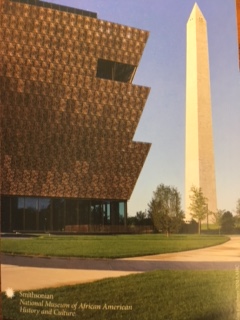
The African-American Museum of History and Culture in Washington, D.C. could hardly be better named. This triumphant work explores both the historical horrors of slavery in the Americas and the life-affirming spirit, achievements and contributions of Africans to our hemisphere’s cultures.
John and I went with few expectations. Tickets to the museum, reserved months ahead, allow for daily timed entries of the hundreds pouring through its halls. Yet the galleries focused on history that we visited first still felt crowded.
To view the historical section, we waited in line to enter a huge, glass-walled elevator with dates posted on one wall. The elevator literally descends four-five floors below ground. Figuratively, we travel back through history from the present to the 1400s, when the first Africans were brought as slaves to the Americas.
The operator notes we have only one way out — by walking the mile and a half up to the main floor through the galleries. We cannot reenter the elevator, and the lower level has no bathrooms. In other words, we have no means of easy escape or access to the normal comforts of our daily lives. I have a premonition of the experience that awaits us.
The lowest levels of the historical galleries are dimly lit with narrow passsageways. People are speaking softly and moving fluidly, even the teenagers on their year-end trips to D.C. But early on I begin to feel squeezed physically and emotionally. I have entered the psychic space of the Middle Passage. I view the artifacts and listen to the narratives. I find myself increasingly close to tears. I’m having difficulty even standing at times. The stark, overwhelming relentlessness of violence and dehumanization our African-American brethren faced over the centuries is challenging my sense of myself as a warrior.
We now start ascending through the historic galleries upward to the present. The level of light increases. We have visual access to other galleries, a better perspective of past, present and future. We see more examples of the fights for empowerment and dignity that the enslaved, former enslaved and their descendants have engaged in. But the history of blood-letting and death — whether by lynchings, police brutality or riots — continues.
Yet African-Americans not only survive their captivity, but also fight to be educated. They succeed in their professions. They honor their communities. They form movements. Their struggles for justice strengthen our democracy and ultimately trump the grisly roots of the African-American experience.
We travel next up to the museum’s top floor to visit the galleries dedicated to culture and community. I’m immediately enthralled by the circular, multi-media design. Quotes from writers, artists, and politicians project onto an open wall as we spiral around the two-sided open column of exhibits.
The section on dance takes me particularly aback. Early documentary movie clips show rural African-Americans dancing steps passed down from their slave ancestors. The clips focus on how these steps evolved and have been integrated into today’s African influences on American popular and classical dance. Rhythm first and foremost: simple, then intricate, requiring skill and a settling into the body of the spirit of movement. Present in these movements are spirits of many dimensions and realms.
All this draws me in, mezmerizes me. The rhythm helps me fully incarnate aspects of my being that I do not regularly access. I feel the three percent of my recently-discovered genome originating in Africa. I look at the film clips. Yeah, that’s me. Down deep, that’s me. Thank you, Mother Africa.
We continue our stroll and encounter Chuck Berry’s convertible Cadillac El Dorado. It is a huge Candy Apple red siren, glistening, undulating though fixed in space. That’s style, man! Then we hear the booming voice of Paul Robeson. I am grateful this giant of humanity has a place where he and his work stand lauded.
I search out the opera singers — Leontyne Price, Jesse Norman, Denise Graves. There they are: divas and door openers to the future. I have seen four Metropolitan Opera productions in the cinema this year. The racial and ethnic diversity of the casts is stunnning considering the overwhelming racial homogeneity of opera only several decades ago. I am happy to celebrate the breadth and depth of the contributions of these musicians and artists to our culture
I leave this space with lifted spirit. I feel joy in my body, a sense of connection and community. I take succor and strength from the stories and reaffirm my resolve to embrace all peoples’ humanity. I reconnect with the core of my being, a warrior of the heart.
I am grateful to all who helped manifest this living monument to human spirit while juxtaposing our humanity-crushing capabilities as well. Thank you for allowing us, through this museum, to have an intimate encounter with your experiences as African-Americans.
I only hope that visitors will use their experience as a springboard to promote more harmony and solidarity among peoples. May we honor the narratives we have seen and heard by meeting others with increased empathy and compassion. May we work for justice. May we create friendships and invite community. Inspiring efforts towards these ends will be the final triumph of this magnificent museum.
Andrea DiLorenzo – May 15, 2018

 Andrea DiLorenzo's Blog - A Place for Insight and Spirit
Andrea, beautiful and moving narrative. Thank you for sharing. I have not been, but is now more interested in going than ever.
LikeLike