My husband, John, and I recently attended an inspiring concert of the Baltimore Symphony Orchestra (BSO) at the 2,000 seat Strathmore Concert Hall here in Montgomery County, MD, a venue that is a 20-minute drive from our home. Strathmore was a public/private venture whose construction was funded by the State of Maryland and Montgomery County in the early 2000s. Before the concert began, we learned that, with this concert, the BSO was celebrating its twentieth year performing at this aesthetically and acoustically superb space. Guest artists such as jazz master Wynton Marsalis and opera diva Joyce DiDonato who we have seen performing in the past several years, both noted from the stage what an outstanding hall it is. We always attend events there with excited anticipation – and have never been disappointed.
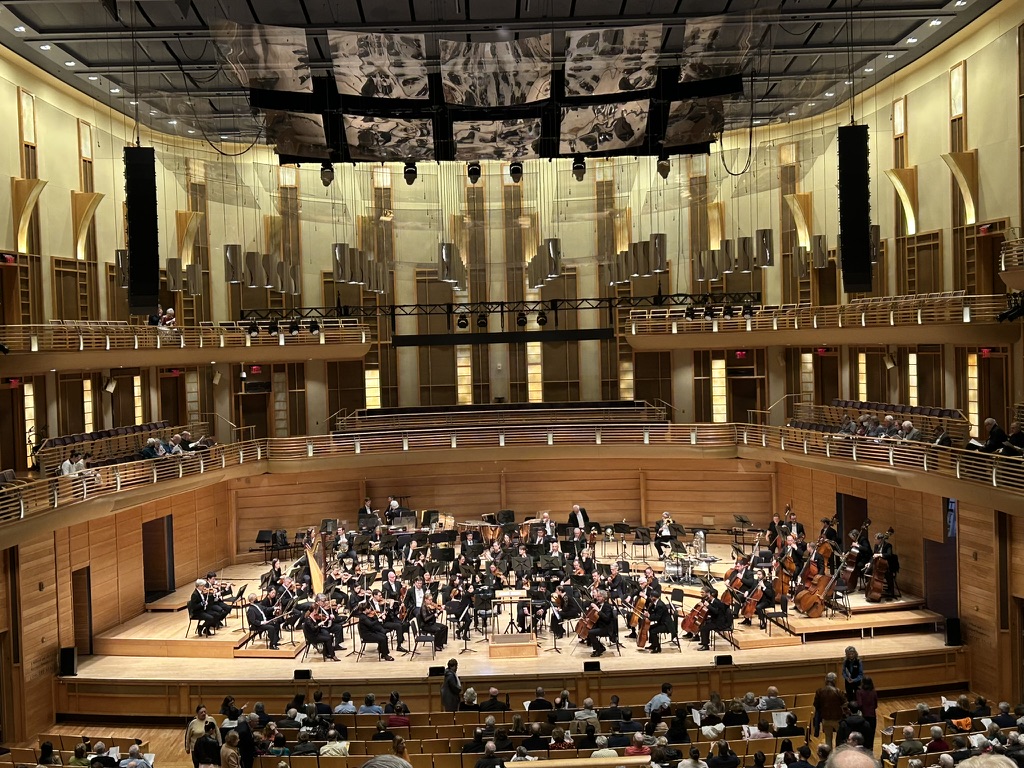
Such was the case at last night’s concert featuring Dvorak’s Carnival Overture, Montgomery’s Five Freedom Songs and Mahler’s Symphony No. 4. The concert was led by the effervescent 33-year-old Jonathan Heyward, named the orchestra’s music director in 2022. African American Heyward, a cellist by training, studied conducting at the Boston Conservatory, completing his degree at the Royal Academy of Music in London. Still in his twenties, he took the helm at several regional orchestras in England and led the Nordwestdeutsche Philharmonie in Germany before his current tenure at the BSO where he replaced renowned Maestra Marin Alsop.

I learned of African American artist Julia Bullock after we saw her German husband Christian Reif conduct the BSO at the Meyerhoff Hall in Baltimore in a 2022 concert featuring soprano Renée Fleming. In seeking information about Reif, I viewed videos on YouTube that Bullock and Reif recorded and posted during COVID in their Berlin apartment with him accompanying her silky, dramatic voice on the piano. I’ve followed this graduate of The Eastman School of Music’s trajectory ever since and remembered before buying tickets to last evening’s concert that she was a knock-out when performing with Metropolitan Opera stars Ailyn Perez and Angel Blue at the 2023 Kennedy Center Honors in the segment honoring Renée Fleming. I therefore anticipated Bullock’s greatness and was not disappointed.

The concert opened with a lively and engaging rendition of Dvorak’s Carnival Overture, a piece I remember fondly having performed in as an oboist in my high school’s orchestral band. Next on the program was Five Freedom Songs, composed by Jessie Montgomery, an African American violinist by training, and a graduate of The Juilliard School who is currently pursuing a Ph.D. in composition at Yale University. She recently completed a term as composer-in-residence at the Chicago Symphony and had been nurtured by the Sphinx Organization, a Detroit-based nonprofit that supports young African American and Latino string players.
Montgomery and Julia Bullock collaborated in the creation of Five Freedom Songs between 2017-2018. The Winter edition of the BSO magazine, “Overture,” noted that the two “wanted to create a song cycle that honors our shared African American heritage and the tradition of the Negro spiritual, while also experimenting with non-traditional stylistic contexts.” The songs were “sourced from the historical anthology Slave Songs of the United States,” originally published in 1867. Bullock sang with emotion and depth and, for some, in the vernacular in which they were sung by the enslaved people who developed them. The audience in the nearly full hall gave Bullock, Heyward and the orchestra a standing ovation, calling them back three times for more applause.
This appreciation was repeated for the performance for the Mahler symphony, a true masterpiece that especially featured the virtuoso playing of the wind section of the orchestra. Bullock joined them for the last movement that incorporated text from the “Das Himmlische Leben” (The Heavenly Life) taken from Das Knaben Wunderhorn (The Boy’s Wondrous Horn), a book of early 19th century German folk poetry. Again, she showed her mastery of the music, the language and her voice which soared above the festive sounds of the instruments.
As I rose, after both the “Songs” and Mahler’s 4th, applauding and cheering to acknowledge the greatness of these artists and the orchestra, I realized I was doing it not only to honor the blood, sweat and tears that I knew went into a performance of this magnitude by all the artists on stage. I was also aware that it was providing me with a spirit-lifting antidote to the news of the day emanating from the crass, even cruel, efforts of the Trump Administration – through its attack on DEI – diversity, equality and inclusion – to wipe out the programs supporting and honoring the artistic and musical contributions of those it deems “other” in our country.
An article in the February 27th, 2025 Washington Post, “Art museum run by OAS nixes two exhibitions,” focused on the Administration’s cancellation of two art exhibits due to open in mid-March at the Organization of American States in Washington. One, “Before the Americas,” was focused on the influence of the transatlantic slave trade and African diaspora across generations of modern and contemporary Black artists. The other, “Nature’s Wild With Andil Gosine,” had the theme of “queer theory and colonial law in the Caribbean.”
Another Post article on the same day, “U.S. Marine Band cancels concert over DEI orders,” focused on the cancellation by the Administration of an upcoming concert in Alexandria, VA in which thirty outstanding high school musicians from around the county, part of the “Equity Arc Wind Symphony,” were to perform with the US Marine Band. The musicians, representing the Black, indigenous, and people of color (BIPOC) community, were selected through highly competitive auditions. The concert would have featured traditional American music as well as the compositions of African American, Latino and Thai American composers.
I was angry and dis-spirited after having read those articles about the wrecking ball taken to these exhibits and concerts – and the aspirations of these artists and musicians by this Administration in the name of – What? An attempt to cancel the vital contributions of those who strive to create beauty and express themselves and the breadth of their experiences in our culturally and racially diverse country? I was on the precipice of feeling shame to call myself American.
Julia Bullock, Jonathan Heyward and the musicians of the Baltimore Symphony Orchestra brought me back from that precipice. They gave me more than a performance last night: they gave me hope and a reason to endure in the fight for justice, as the enslaved people who developed and sang those “Slave Songs” did over the centuries of their experience of violence and denigration. It will take more than an Administration steeped in cruelty, delusion and grievance to defeat that real American spirit. This is the American spirit to which I pledge my allegiance – now and for the remainder of my time on this earth.
Andrea DiLorenzo – 2/28/2025

 Andrea DiLorenzo's Blog - A Place for Insight and Spirit