
“RBG & ME: A Movie Review & Life Retrospective

I recently saw the new documentary film, “RBG,” about the life of the nation’s second female Supreme Court Justice Ruth Bader Ginsburg. The film is definitely one to see. It is a comprehensive view of her life and work. It made me laugh and cry and gave me hope for the future. I learned of Ginsburg’s personal life and her outsized contributions to women’s rights over her nearly seventy years in law. The film’s title is a riff off the moniker of the Rapper Notorious BIG. Since Ginsburg has been declared by many on the political Right as “notorious” and “evil,” this seems apt. It also showed the fan base she has among the nation’s young. She has rock star status, a complete surprise to me.

“RBG” also sparked rich memories about my own career. I arrived in the nation’s capital after college in 1973 as the second wave of feminism was hitting its stride. I was fortunate enough to land a good job in the international division of a labor union, an early career goal. My boss was a feminist committed to advocating for an enhanced role for women in the labor movement.

When I first began working, I was too focused on my own endeavors to take in that I was part of a growing force of women that included intellectual giants such as Ruth Bader Ginsburg.  As time went on, however, I met more and more women on the front lines: labor advocates and workers, professors, diplomats and lawyers. Their common goal was equal rights and protections for women in education, under the law and in the workforce. I had found my career focus.

“RBG” featured much archival footage. There were early photos and home movies of Ginsburg’s life. There was also coverage of early feminist marches and protests. One still shot featured women wearing tee shirts emblazened with the logo for the United Nations International Women’s Year – a dove enveloping the biological symbol for a woman. That was back in 1975, a seminal year for me. In addition to doing women’s labor advocacy work in the US, my duties increasingly extended to learning about and working with women from other countries.

At the time, I didn’t realize that my work on international women’s issues would lead directly to a life-changing opportunity. After several years, I became restless with my job, feeling I would hit a glass ceiling at that union before long. So, like a lot of my college classmates, I began applying to law school. Halfway through the process though, I knew studying law was not for me. I couldn’t even bring myself to finish the applications.

Instead, a serendipituous encounter with a college friend opened another avenue. When I whined of my half-hearted desire to attend law school, he said: “What do you really want to do?” Immediately, I responded: “I want to live in Italy.” He shared that Oberlin, our alma mater, offered alumni fellowships to such endeavors if they were backed with an academic focus. I submitted a proposal to study the role of women in Italian labor unions within the context of UN International Women’s Year initiatives. My proposal was accepted. Shortly afterward I began night classes learning Italian at Georgetown University.

Though the fellowship from Oberlin was modest, it was enough to prompt me to request a leave of absence, plan for my year abroad and start to bring my few belongings to my folks’ place in Pennsylvania. Just before I was to leave for my year in Rome, another opportunity opened up. My employer decided to participate in a training program for women active in transport unions throughout Southeast Asia. My last assignment, along with my director and another friend of ours, a feminist psychologist, was to co-teach at this program held in Penang, Malaysia.

There were women from ten Southeast Asian countries present. We, as American feminists, were sent to spread the good news of women’s liberation and to encourage union activism among our female ranks. We gave workshops focused on assertiveness and other issues. The women soaked up what we had to offer and we had very rich cultural exchanges.  But there was additional icing on the cake for me.

Rather than return to the States after the Malaysian program to begin my leave of absence, I chose to keep going west, traveling for more than two months before reaching Rome. Through my contacts in the US labor movement, I had set up meetings with women’s activists and trade unionists in Indonesia, Thailand, Bangladesh, Nepal, India and finally, Egypt. What an experience for a twenty-five year old, working-class girl from New Castle, PA. I sometimes pinched myself to believe it was real. I had intended to visit more countries, getting visas before leaving the States for travel in Iran and Afghanistan. It was only after being on the road in Asia that people began to warn me, as a single woman, against those stops. I was naive about the level of anti-American sentiment and the rising role of the conservative clerics and the Taliban.

It wasn’t always easy: I became ill with parasites that plagued me for a year afterward, and I grew lonely at times. But I kept moving and met many fascinating people along the way. Asia became for me the multicultural place it really is, expanding my previously-limited notion of it as China, Japan and Vietnam. The trip was mind-blowing! Though I had traveled and lived previously in Latin America and Europe, my Asia experience truly opened the world’s diversity to me.

Just as the future Supreme Court justice was slowly building a foundation for groundbreaking legal precedents in the US, the women I met on this trip were forging new paths for women – who were denied equal rights in nearly all realms of their societies. Many were eager to learn about American feminism and I learned a lot from them. And I would to learn and contribute to the ongoing force of women’s rights as I entered the next phase of my life’s journey – my year in Rome.

To be continued –

I Keep Seeing Snakes


th.jpeg

On Saturday, May 19th, 2018, the world was celebrating the Royal Wedding. I had some excitement of my own, but of a very different nature. John and two of his sisters, visiting from Western New York, were attending the annual Gaithersburg Book Festival. I stayed behind with lingering bronchitis. On this cool, rainy day I did not want to be outside. Mid-morning, I was enjoying CNN’s rebroadcast excerpts from the Wedding. During a commerical break, I decided to do some laundry. After gathering the clothes, I headed to the basement.

Getting to the bottom of the stairs, I glanced down a few feet ahead of me and saw a small snake, some 8-10 inches long, that I feared was a baby Copperhead. The markings were ominously similar to those of the large Copperhead John found last year in our barbeque. Recently, Copperheads, one of several venomous snakes in Maryland, have been sited in our local area. A newspaper article last year detailing the severity of Copperhead bites for a local woman left me with the jitters.

Mentally, I went into action immediately. I thought through how to capture the snake, deciding at last to use a round two quart plastic leftover bowl. It would nicely contain the coiled creature. I also realized I needed something to allow me to get it from a distance.

At that moment, I wished I had one of those long, “pick-up” gadgets. My longest kitchen tongs are about 18 inches. They did not seem quite long enough. Yet, they were better than nothing. Looking around the basement for other potential tools, I grabbed a heavy glass lid for a large frying pan I store there. This would be my “shield” which I held in my left hand. In my right, I gripped the outside of my plastic container with my tongs and neared to the snake. I was ready for action.

When I first went into the basement, it took a minute for the the snake to realize I was there. Keeping my distance, I circled it several times, assessing the best place to effectively capture it. I planned a variation of my insect “trap & release” technique:  Place a container over a creature, slide a piece of cardboard underneath and release it outside. This technique has worked well for me – and the insects I capture – nearly 100 percent of the time.

Soon after I began circling it, the snake began to follow my movements. I felt like the proverbial snake charmer but without music. As I moved, the snake raised its head straight from its coiled body, turning and following my movements closely. Its tail rattled. It  opened its mouth wide showing its small fangs. I realized capturing a venomous snake was on another order of magnitude than capturing insects.

In the moment, I was not scared. I firmed myself mentally to overcome any lurking, primal fears. I remembered my goal of removing the snake from the house as quickly as possible. My mind turned over a number of ways to get the snake, yet none really took. I accepted the reality that this job was more than I could handle alone. With John away, I called our neighbor, an outdoorsman who I knew would be willing to help.

After explaining my plight, my neighbor arrived immediately. He wore heavy boots, and had a flashlight along with his “pick-up” gadget. “It was my mother’s,” he laughed as I expressed envy of his having such an appropriate tool for the task.

Descending to the basement, he shined his light directly at the snake. He then quickly but gingerly reached over and put the catch piece of the grabber over the snake’s neck. He looked at it more closely. “Yes,” he said. “It’s a Copperhead. What do you want me to do with it?” I put the snake’s fate in his hands and left the basement.

As my neighbor passed me on his way outside to dispose of the wriggling snake, I finally experienced a primal reaction. My body shuddered and low squeals of fear came out of my mouth. Fortunately, it lasted only a few seconds.

That Copperhead snake now owns a piece of my psyche. Going to the basement, as I do daily, I look for its relatives. I see snakes in the shadows on the basement floor. I imagine them crawling out of rolled-up carpets or other stored items. My ease of movement has changed. My literal encounter with that Copperhead lasted about fifteen minutes. Emotionally and psychically, it will be with me a lot longer.


Andrea DiLorenzo (c)

May 25, 2018

White Chrysanthemum – A Book Review

34701167 “White Chrysanthemum” is a historical novel, published “in 2018, by American author Mary Lynn Bracht.  This bold endeavor shines a light on the nearly-forgotten history of the so-called “comfort women” exploited sexually by the Japanese Imperial Army during World War II. It took determination to stay with Bracht’s telling of the brutality of the era. Bracht subjects are the young girls and women abducted from their homes or tricked into sexual slavery. She does not shy from the horrors they suffered at their captives’ hands. The details sometimes come with a strong emotional punch.
Bracht’s characters live in an occupied society annexed by Imperial Japan in the early 20th century. Koreans spoke Japanese and were educated in Japan’s history and culture. Speaking, reading or writing Korean was prohibited. Things intensifed for Koreans as Japan’s involvement in the broader conflicts with the Soviets, the Chinese and then the Allies became World War II. Bracht also details the slaughter of suspected pro-communist civilians by South Korea in the late 1940s.

Bracht’s research was thorough as is her deep compassion for the Korean women who suffered and died as “comfort women.”  The story wove in and out of, chapter by chapter, the lives of two sisters, Hana and Emi. Hana was abducted into forced sexual slavery; Emi was left behind to live a long life never knowing her older sister’s fate. Bracht, whose mother is Korean, was led to write the novel after visiting the memorial in Seoul to these often forgotten victims of war in 2016.

We learn of the proud history, dating back to the 17th century, of thehaenyeo, the deep sea diving women of Jeju Island, about one hundred miles off the southern coast of Korea in the East China Sea. The haenyeoare known for their independent spirit and bravery as they free dive year-round into the depths catching shell fish and other delicacies. The role of the haenyeoled directly to the semi-matriarchal nature of Jeju Island’s culture.

The novel opens with a dream-like description of eleven year-old Hana’s shamanistic initiation into the haenyeoworld. Shortly thereafter we are brought to the horrors wreaked on Hana as a sixteen year-old kidnapped and raped by a Japanese corporal, Morimoto. His life is then entwined with hers until near the end of the book. The rape is her initiation into brothel life where she services thirty to forty soldiers a day for several years.

Bracht does not spare the reader the harrowing details even of routine gynecological exams forced upon the “comfort  women,” their washing of used condoms and the sadistic rituals committed on their bodies. Hana is the vulnerable but strong teenager who weeps for her family, agonizing for their well-being after her abduction, hoping against hope that her father is searching for her.  Yet, as the trains with blackened windows she rides with other female captives take Hana further and further from home, they bring readers face to face with the stark reality for the majority of these estimated 200,000 Korean women. Most perished or never returned to their families. Morimoto eventually takes Hana to a brothel in Manchuria and then to Mongolia as Japan begins losing the war. In Mongolia, Hana is left with a poppy-growing family of nomads. This changes her fate, rendering some of the most touching encounters Hana has in the nightmare that has become her life.

We learn of Emi’s story through the retrospective lens of her now seventy five years. A widow in poor health, she is a haenyeowho still dives daily. Her relationship with the sea is beautifully told. We learn of her unfulfilled life in a forced marriage to a North Korean man after her father is killed and her mother kidnapped as a political prisoner during the Korean civil conflict. Through this marriage, Emi mothers two children while her husband inherits her parents’ property. Her now grown daughter who eschewed becoming a haenyeo, is a professor in Seoul living with an American women lover. Her son is the father of one grandson on whom Emi dotes.

But Emi’s memory of the trauma of her sister’s disappearance and her parents’ horrible fate has led to much self guilt, leaving her emotionally cut off. On what she believes will be her last visit with her children in Seoul, Emi reluctantly attends the thousandth “Wednesday demonstration” which gives new meaning to her life.  The demonstrations take place across from the Japanese embassy in Seoul and call for Japan to “admit is crimes,” with reparations for the “comfort women.” The demonstrations began in reality after several of the surviving “comfort women” filed suit against the Japanese government in 1991. This led to a formal apology to some of the remaining women and to the establishment of a compensation fund for victims from Korea, the Phillippines, Indonesia, Taiwan and the Netherlands.

Emi’s sighting of a statue of a “comfort woman” unveiled at the demonstration draws her due to its uncanny likeness to her sister. Emi is sure Hana was the statue’s model. Emi has new hope of finding Hana alive. Regardless, her life force now is reignited through connecting with Hana’s spirit, if only through the statue. This section of the novel reveals the symbolism of its title “White Crysthanthemum.”

Readers will not soon forget Bracht’s book. She brings heart and honor to the civilian victims of the horrors of war. In her Author’s Note, Bracht writes that her pilgrimage to Seoul in 2016 allowed her to see the Statue of Peaceas a symbol of  “wartime rape of not only Korean women and girls, but all women and girls the world over.” She calls for the inclusion of “women’s wartime suffering in history books,” commemoration of “the atrocities against them in museums, and” remembering “the lost women and girls by erecting monuments in their honor.”

Andrea DiLorenzo

May 31, 2018

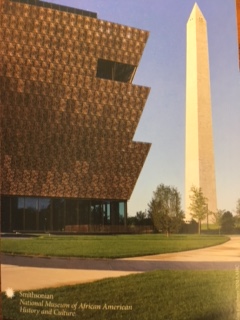
A First Visit to the Museum of African-American History and Culture

IMG_0336

The African-American Museum of History and Culture in Washington, D.C. could hardly be better named. This triumphant work explores both the historical horrors of slavery in the Americas and the life-affirming spirit, achievements and contributions of Africans to our hemisphere’s cultures.

John and I went with few expectations. Tickets to the museum, reserved months ahead, allow for daily timed entries of the hundreds pouring through its halls. Yet the galleries focused on history that we visited first still felt crowded.

To view the historical section, we waited in line to enter a huge, glass-walled elevator with dates posted on one wall. The elevator literally descends four-five floors below ground. Figuratively, we travel back through history from the present to the 1400s, when the first Africans were brought as slaves to the Americas.

The operator notes we have only one way out — by walking the mile and a half up to the main floor through the galleries. We cannot reenter the elevator, and the lower level has no bathrooms. In other words, we have no means of easy escape or access to the normal comforts of our daily lives.  I have a premonition of the experience that awaits us.

The lowest levels of the historical galleries are dimly lit with narrow passsageways. People are speaking softly and moving fluidly, even the teenagers on their year-end trips to D.C.  But early on I begin to feel squeezed physically and emotionally. I have entered the psychic space of the Middle Passage. I view the artifacts and listen to the narratives. I find myself increasingly close to tears. I’m having difficulty even standing at times. The stark, overwhelming relentlessness of violence and dehumanization our African-American brethren faced over the centuries is challenging my sense of myself as a warrior.

We now start ascending through the historic galleries upward to the present. The level of light increases. We have visual access to other galleries, a better perspective of past, present and future. We see more examples of the fights for empowerment and dignity that the enslaved, former enslaved and their descendants have engaged in. But the history of blood-letting and death — whether by lynchings, police brutality or riots — continues.

Yet African-Americans not only survive their captivity, but also fight to be educated. They succeed in their professions. They honor their communities. They form movements. Their struggles for justice strengthen our democracy and ultimately trump the grisly roots of the African-American experience.

We travel next up to the museum’s top floor to visit the galleries dedicated to culture and community. I’m immediately enthralled by the circular, multi-media design. Quotes from writers, artists, and politicians project onto an open wall as we spiral around the two-sided open column of exhibits.

The section on dance takes me particularly aback.  Early documentary movie clips show rural African-Americans dancing steps passed down from their slave ancestors. The clips focus on how these steps evolved and have been integrated into today’s African influences on American popular and classical dance. Rhythm first and foremost: simple, then intricate, requiring skill and a settling into the body of the spirit of movement. Present in these movements are spirits of many dimensions and realms.

All this draws me in, mezmerizes me. The rhythm helps me fully incarnate aspects of my being that I do not regularly access. I feel the three percent of my recently-discovered genome originating in Africa. I look at the film clips. Yeah, that’s me. Down deep, that’s me. Thank you, Mother Africa.

We continue our stroll and encounter Chuck Berry’s convertible Cadillac El Dorado. It is a huge Candy Apple red siren, glistening, undulating though fixed in space. That’s style, man! Then we hear the booming voice of Paul Robeson. I am grateful this giant of humanity has a place where he and his work stand lauded.

I search out the opera singers — Leontyne Price, Jesse Norman, Denise Graves.  There they are: divas and door openers to the future. I have seen four Metropolitan Opera productions in the cinema this year.  The racial and ethnic diversity of the casts is stunnning considering the overwhelming racial homogeneity of opera only several decades ago. I am happy to celebrate the breadth and depth of the contributions of these musicians and artists to our culture

I leave this space with lifted spirit. I feel joy in my body, a sense of connection and community. I take succor and strength from the stories and reaffirm my resolve to embrace all peoples’ humanity. I reconnect with the core of my being, a warrior of the heart.

I am grateful to all who helped manifest this living monument to human spirit while juxtaposing our humanity-crushing capabilities as well. Thank you for allowing us, through this museum, to have an intimate encounter with your experiences as African-Americans.

I only hope that visitors will use their experience as a springboard to promote more harmony and solidarity among peoples. May we honor the narratives we have seen and heard by meeting others with increased empathy and compassion. May we work for justice. May we create friendships and invite community. Inspiring efforts towards these ends will be the final triumph of this magnificent museum.

Andrea DiLorenzo – May 15, 2018